
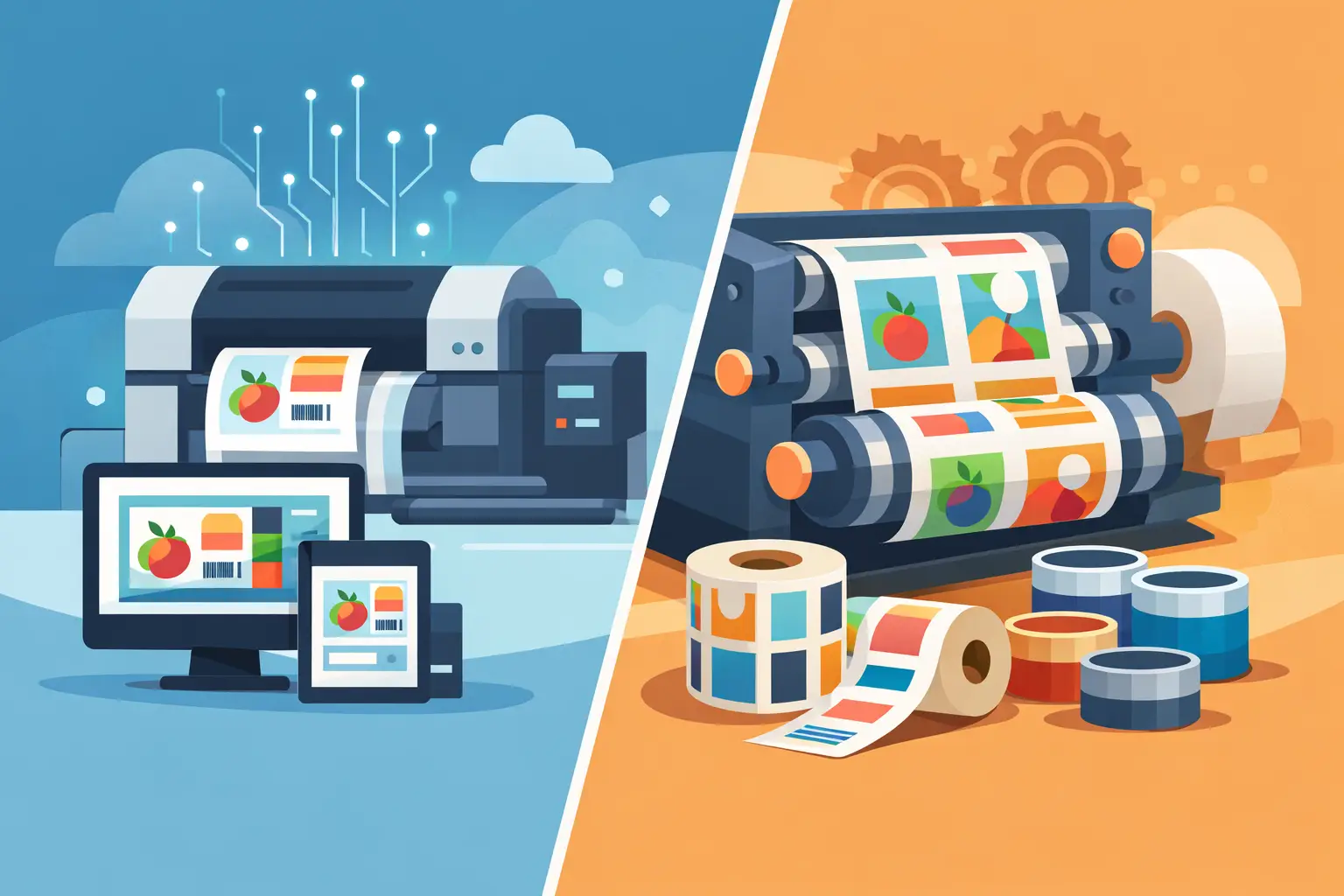
If you are sourcing labels for a product launch, line extension, or ongoing production run, the choice between digital vs flexographic labels affects more than print method. It affects cost per run, lead time, version control, color expectations, and how easily your label program can scale as demand changes.
For most buyers, the real question is not which method is better in general. It is which method fits the job in front of you. A short run for a seasonal beverage, a regulated pharmaceutical label, and a high-volume food product may all require different production decisions. The right answer depends on run length, artwork complexity, substrate, compliance needs, and timeline.
Digital vs Flexographic Labels: The Core Difference
Digital printing produces labels directly from a digital file, without the need for printing plates. That makes it well suited for shorter runs, faster changeovers, and projects with multiple versions or variable data.
Flexographic printing uses custom plates to transfer ink to the label material. Plate setup adds time and upfront cost, but once a job is running efficiently, flexography can be a strong option for long, repeatable runs at high volumes.
That difference in setup drives most of the trade-offs buyers care about. Digital often reduces prepress time and supports agility. Flexographic often rewards volume and consistency over long production cycles.
When Digital Labels Make More Sense
Digital label printing is often the better fit when speed and flexibility matter as much as unit cost. If your team is launching a new SKU, testing regional packaging, or managing frequent artwork changes, digital can remove a lot of friction from the process.
Because there are no plates to produce, approval cycles can move faster. You can update ingredient panels, revise branding, or create multiple product versions without rebuilding the job from scratch. That is especially useful for brands with seasonal promotions, craft beverage releases, private label programs, or products that require market-specific packaging.
Digital also performs well for shorter to mid-range runs where plate costs would otherwise weigh heavily on the economics. A buyer ordering several small batches with different designs may find digital more cost-effective overall, even if the per-label math changes at higher quantities.
Modern digital equipment also delivers strong print quality. With advanced presses such as the HP Indigo 6900 Digital Press, brands can achieve sharp detail, smooth gradients, and excellent color performance for labels that need to look polished on the shelf.
When Flexographic Labels Make More Sense
Flexographic labels remain a highly effective option for many production environments, particularly where volumes are high and the artwork is stable. If a product runs the same label month after month with minimal changes, flexography often becomes more economical over time.
Once plates are made and the press is set up, flexographic printing can produce large quantities efficiently. For established products with predictable demand, that setup investment can be justified quickly. This is common in food, beverage, household goods, and industrial categories where repeat orders are large and packaging stays consistent.
Flexography is also a strong fit when a job requires specialty inks, coatings, or material combinations tied to a specific application. Depending on the label construction and end-use environment, flexo may offer production advantages that align well with durability, adhesive performance, or finishing requirements.
That said, flexography is less forgiving when frequent revisions are expected. New versions usually mean new plates, additional setup, and more production planning.
Cost: The Part Every Buyer Has to Get Right
Cost is where digital vs flexographic labels usually gets the most attention, and for good reason. But the lowest price depends on the job structure, not just the print method.
Digital printing generally has lower upfront costs because there are no plates. That makes it attractive for short runs, pilot programs, and projects with multiple SKUs. If you need 10 versions of the same basic label with small text changes, digital can keep total project cost under control.
Flexographic printing usually carries higher setup costs at the beginning because of plate creation and press preparation. However, as volumes increase, the cost per label can come down significantly. For large repeat orders, flexo may deliver the better long-term value.
This is why buyers should look beyond a simple per-thousand price comparison. A method that appears cheaper on a single quote may become more expensive if artwork changes are frequent, inventory becomes obsolete, or lead times create operational delays.
Print Quality and Brand Presentation
Both methods can produce high-quality labels, but they serve different production goals.
Digital printing is often preferred for artwork that includes fine detail, complex graphics, photographic elements, or frequent design variation. It can be an excellent choice for health and beauty labels, premium beverage labels, and consumer-facing products where appearance directly supports brand value.
Flexographic printing also delivers strong results, especially on repeat work with well-established specifications. Solid colors, clean layouts, and high-volume consistency are often where flexography performs well. For many packaging programs, the difference is not whether one looks good and the other does not. It is how the print method aligns with the visual demands of the design and the economics of the run.
Color management is another practical factor. If your brand depends on tight color consistency across multiple runs and SKUs, your printer should evaluate that requirement with you before production begins. The best outcome comes from matching the process to the expectation, not forcing every job through the same workflow.
Turnaround Time and Production Agility
When deadlines are tight, digital usually has the advantage. Without plate production and with less setup complexity, digital jobs can often move into production faster. That matters when a launch date changes, inventory runs low, or an updated compliance panel has to be implemented quickly.
Flexographic jobs can still run efficiently, especially in scheduled repeat production, but they generally require more planning at the front end. If your purchasing cycle is stable and your forecast is reliable, that may not be a problem. If your packaging needs shift frequently, it can become one.
For companies balancing supply chain pressure with changing market demand, agility has real value. A faster label decision can keep production moving and reduce the risk of carrying outdated inventory.
Versioning, Compliance, and SKU Complexity
This is where digital can offer a clear operational advantage. Products in pharmaceuticals, nutraceuticals, food, and specialty consumer goods often require multiple versions of the same label. You may need different languages, formulations, warning statements, batch coding, or market-specific text.
Digital printing handles versioning efficiently because changes can be made at the file level without requiring new plates for each variation. That streamlines smaller runs and helps buyers avoid ordering more labels than they need just to make setup costs work.
Flexography can support regulated and complex labels as well, but the process is usually better suited to stable artwork that does not change often. If your label content is in motion, digital may reduce waste and simplify management.
So Which Option Is Right for Your Labels?
If your priority is short runs, fast turnaround, multiple versions, or frequent artwork changes, digital is often the practical choice. If your priority is long, repeatable production at high volume with stable artwork, flexography may be the stronger fit.
In many label programs, the answer is not strictly one or the other. Different products within the same portfolio may call for different methods based on demand, packaging updates, and budget. An experienced manufacturing partner should be able to evaluate each job on its own requirements instead of pushing a single process for every order.
At Miles Label Company, that production-first approach matters. Buyers need more than a print vendor. They need a partner who can assess run length, substrate, compliance needs, finish requirements, and schedule pressure, then recommend the process that supports quality and cost control.
The best label decision is the one that fits your product now and still works when your volume, artwork, or timelines change. If your team is comparing options, start with the realities of the job, and the right print method usually becomes clear.