
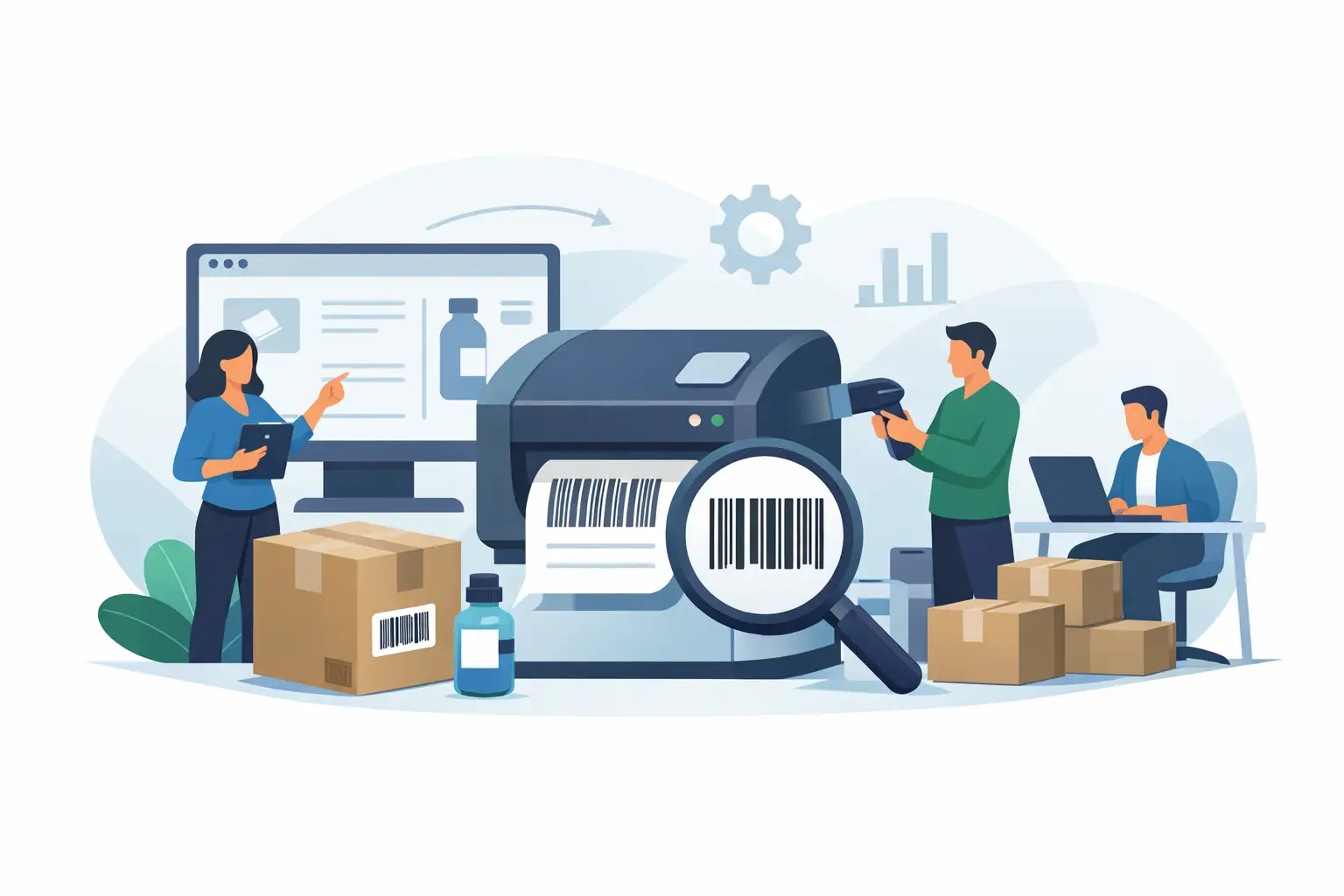
A barcode that scans reliably on a clean sample can still fail on the production line, in a warehouse, or at retail checkout. The difference is often not the barcode data itself. It is the relationship between code selection, label material, print method, package shape, and the conditions the finished product will face. This barcode label printing guide is designed for product teams that need labels to look professional, meet operational requirements, and scan accurately from first shipment through repeat orders.
Start With the Barcode’s Job
Before selecting a label stock or approving artwork, define where the barcode will be scanned and what system will read it. A retail UPC has different requirements than a Code 128 barcode used for internal inventory, and both differ from a serialized 2D code used in a regulated supply chain.
For consumer products sold at retail, UPC-A is common in the United States. EAN codes may be required for distribution outside the U.S. or by certain retailers. Code 128 is often used for cartons, shipping labels, and industrial applications because it can hold more information in a compact format. QR codes and Data Matrix codes can carry more data in less space, but only when the receiving system is equipped to read them.
The practical rule is straightforward: use the symbology required by your customer, retailer, warehouse management system, or regulatory program. Do not choose a code based only on how it looks in the artwork. A barcode must support the intended workflow, including the scanner type, expected scan distance, and data format.
Match Data to the Symbology
A UPC typically identifies a retail item. It does not replace lot codes, expiration dates, or traceability information. If your operation needs changing data, such as batch numbers or serial numbers, determine whether variable-data printing, a separate overprint area, or a different barcode structure is needed.
This early decision affects the production plan. Static codes can be printed as part of the label design. Variable codes require accurate source data, controlled sequencing, and a process to confirm that every printed code matches the intended record.
Design for Scanability, Not Just Appearance
Barcode quality begins in prepress. A code can be technically present yet difficult to scan because it is too small, distorted, crowded by graphics, or printed with poor contrast.
The bars and spaces need a clear, high-contrast background. Black bars on white are the standard for a reason. Dark blue, dark green, or deep brown may work in some cases, but visual appearance is not a dependable measure of scanner performance. Metallic inks, transparent varnishes, textured papers, and busy backgrounds can also affect readability.
Keep the required quiet zones clear. These blank spaces on either side of a linear barcode allow a scanner to identify where the code begins and ends. Logos, type, borders, and color blocks should not intrude into them. A code may appear centered and attractive after those areas are removed, but it may no longer perform consistently.
Barcode orientation also matters. On round bottles, jars, and tubes, placing a linear barcode in a ladder orientation can reduce distortion caused by the package curve. The correct placement depends on container diameter, code size, and where the label seam falls. For small containers, a 2D code may be more practical, but only if it is accepted by the downstream system.
Choose a Print Method That Holds Detail
The best barcode label printing approach depends on run length, variable data, required resolution, color expectations, and the label’s end use. There is no single process that fits every product.
Digital label printing is especially useful for short to mid-size runs, frequent artwork updates, multiple SKUs, and variable-data applications. It supports fast turnaround and can deliver sharp barcode detail alongside full-color product graphics. For brands managing seasonal flavors, regional versions, compliance changes, or test-market quantities, digital production can reduce the need to hold large inventories of outdated labels.
Conventional print processes may be a strong choice for high-volume, repeat programs where the artwork and quantities are stable. The right option should be based on the total production requirement, not solely on a per-label price. Consider setup costs, minimum quantities, revision frequency, storage, obsolescence risk, and lead time.
For barcode applications, print consistency is critical. Fine bars, small 2D modules, and reverse-print designs leave less room for variation. Modern digital equipment, including presses such as the HP Indigo 6900, can provide the detail and color control needed for demanding label programs when the job is engineered correctly.
Select Materials for the Actual Environment
A barcode label is only useful while it remains attached, legible, and scannable. The material must suit the package and its environment, whether that means refrigeration, moisture, abrasion, chemicals, oil exposure, sunlight, or frequent handling.
Paper labels can be cost-effective and appropriate for dry, indoor products. They are widely used for food packaging, wine, specialty goods, and other applications where the label will not face sustained moisture or abrasion. Film materials, such as polypropylene or polyester, are often better suited for water bottles, health and beauty containers, household chemicals, industrial products, and refrigerated items.
Adhesive selection deserves the same attention as face stock. A label may need to adhere to glass, plastic, corrugated cartons, painted metal, or a low-energy surface. It may be applied to a cold container, exposed to condensation, or required to remain in place after repeated handling. The wrong adhesive can cause edge lift, flagging, or complete label failure, even when the printed barcode is perfect.
Protective finishes can help preserve barcode quality. Lamination or varnish may protect against scuffing and moisture, but the finish must be compatible with the barcode design. Highly reflective or textured finishes can introduce scan issues in certain lighting conditions. Testing the finished construction is more valuable than assuming a material will work because it performed well on another product.
Plan Barcode Placement With Packaging in Mind
Placement is a production and operations decision, not just a design decision. A barcode hidden under a package flap, placed across a seam, wrapped around a sharp curve, or positioned where a consumer regularly grips the container may be difficult to scan or quickly damaged.
For retail items, leave enough room for the code at its approved size and avoid placing it near folds, gussets, or high-gloss visual effects. For case and pallet labels, ensure the barcode can be scanned from the expected approach angle and distance. Warehouse staff should not need to rotate or restack a case to capture the data.
If the label will be applied by machine, confirm the application method before finalizing the layout. Sensor marks, die-cut shape, label unwind direction, and application tolerances can influence where the barcode can safely sit. This is particularly relevant for wrap labels, small-diameter containers, and high-speed packaging lines.
Verify Before Full Production
A smartphone camera is useful for a quick check, but it is not a barcode verification program. A code that opens on a phone may still fail a retail scanner or fall outside an applicable quality standard.
Verification measures the printed barcode against defined criteria, including contrast, edge definition, modulation, defects, and decodability. For retail UPCs and other mission-critical codes, verification should be part of the approval process, especially when changing material, print process, size, color, or package format.
A practical approval sequence includes reviewing the final barcode data, checking the code at intended size, producing a representative sample on the selected material, and testing or verifying the finished print. For variable-data jobs, add controls for file accuracy, duplicate prevention, sequence management, and reconciliation. The cost of this work is small compared with rejected shipments, retailer chargebacks, or inventory delays.
Build Repeatability Into the Program
The first label run is where the technical choices are made. Repeat orders are where those choices prove their value. Document approved barcode specifications, materials, adhesives, finishes, placement, color treatment, and inspection requirements so future production remains consistent.
This documentation is particularly valuable when a product line expands. A new flavor, fragrance, size, or package shape may use the same brand design but require a different barcode size or label construction. Treat each packaging change as an opportunity to confirm performance rather than assuming the original solution transfers without adjustment.
Miles Label Company works with product teams to align artwork, materials, press capabilities, and production requirements before labels reach the line. The goal is not simply to print a barcode. It is to produce a label that supports the way your products are packed, tracked, shipped, displayed, and sold.
A dependable barcode program starts with a clear use case and ends with a finished label tested for its real environment. Bring those details to the quoting stage, and your label partner can help make the right production decisions before a scanning problem becomes a costly operational problem.