
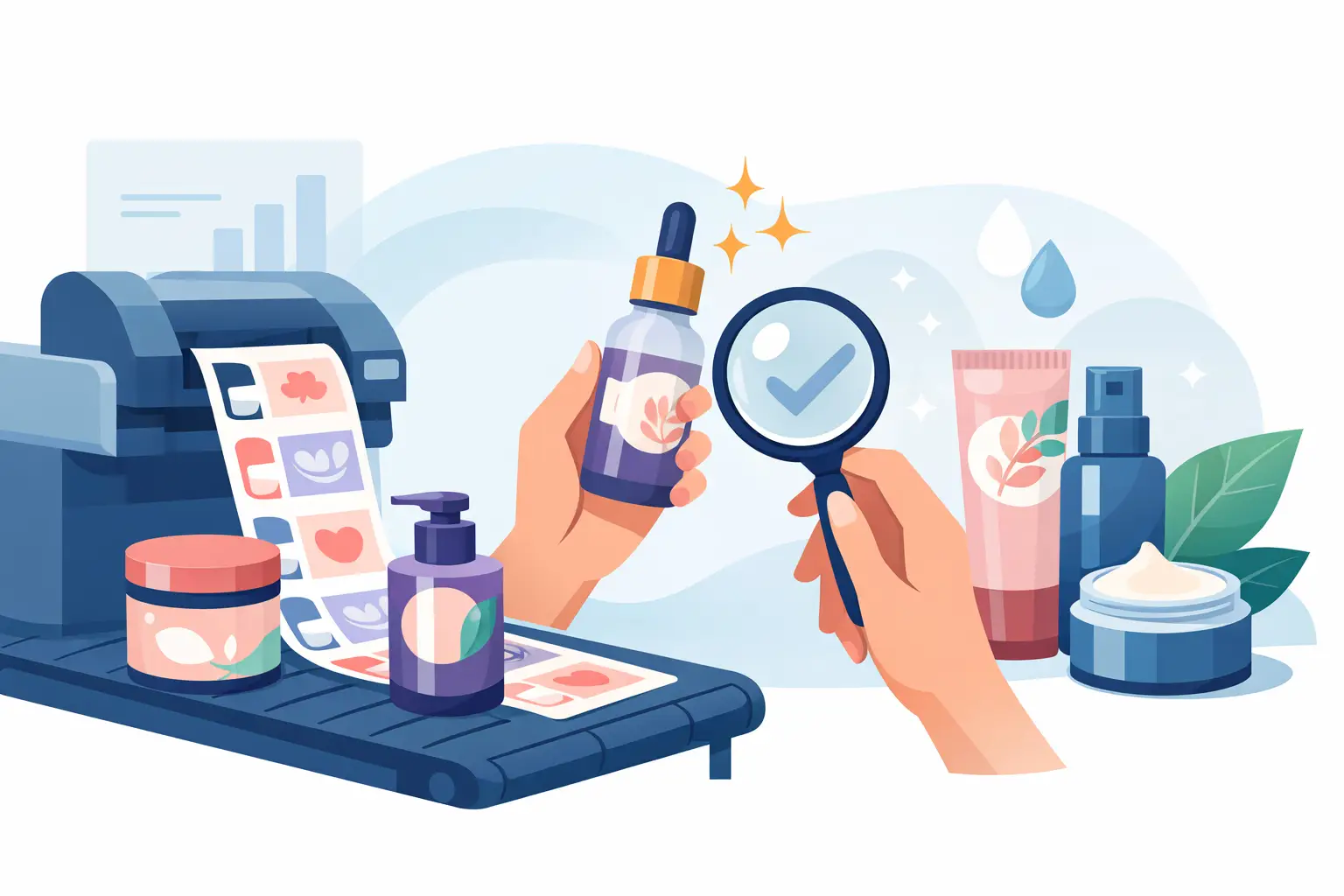
A cosmetic label has to do more than look good under retail lighting. It has to stay readable in humid bathrooms, hold up to oils and repeated handling, and present the product in a way that feels consistent with the brand. That is why custom cosmetic label printing is usually less about decoration and more about making smart production choices early.
For beauty brands, contract manufacturers, and packaging buyers, the label sits at the intersection of branding, compliance, and operations. A soft-touch finish may elevate a premium serum line, but if the material scuffs during filling or the adhesive struggles on a curved bottle, the visual impact will not matter for long. The best result comes from balancing appearance with real-world performance.
What custom cosmetic label printing needs to solve
Cosmetic packaging tends to face more demanding conditions than many consumer products. Labels may be applied to glass jars, squeezable tubes, pump bottles, or compact containers with limited printable space. Those packages are then exposed to moisture, friction, oils, and temperature changes during shipping, storage, and daily use.
That creates a different set of priorities than a simple paper label on a dry, shelf-stable product. Print quality still matters, especially in a category where color, finish, and overall presentation influence buying decisions. But cosmetic labels also need material compatibility, dependable adhesion, legible small text, and repeatable production from run to run.
When buyers treat label printing as a late-stage purchase instead of a packaging decision, problems show up quickly. Colors shift between orders, embellishments do not match the brand standard, or a label that looked fine on a sample sheet fails once it is applied at production speed. A capable printer helps prevent that by evaluating the label as part of the product system, not just as artwork on a roll.
Key decisions in custom cosmetic label printing
The right label specification depends on the product, container, and market position. A luxury skincare line and a high-volume personal care product may both need excellent print, but they often require different production strategies.
Material selection affects durability and appearance
Film materials are common in cosmetics because they handle moisture and handling better than standard paper stocks. They can also create a cleaner, more premium look on many containers. Paper can still be a strong option for some applications, especially when texture or a natural aesthetic supports the brand, but it is more sensitive to wet environments and abrasion.
The choice often comes down to how the product will be used. A face cream jar kept on a bathroom counter has different demands than a boxed cosmetic item with minimal contact after purchase. It depends on the surface, the environment, and how long the label needs to stay intact while preserving brand appearance.
Adhesive choice is not a minor detail
Adhesive performance is one of the most overlooked parts of cosmetic labeling. Containers may be glass, PET, HDPE, or specialty packaging with coatings that affect bond strength. Some are flat and easy to label. Others taper, curve sharply, or carry slight surface texture that makes adhesion more difficult.
An adhesive has to match both the substrate and the application conditions. If products are filled cold, shipped through warm climates, or stored in humid spaces, those factors matter. A label that lifts at the edge or wrinkles after application creates waste, rework, and a poor customer impression.
Finish and decoration should fit the brand and the process
In beauty packaging, finish often carries as much weight as color. Gloss can make colors pop and support a polished, modern look. Matte can signal sophistication or a clinical aesthetic. Metallic effects, clear constructions, and tactile finishes can add distinction, but each choice comes with trade-offs in cost, lead time, and production complexity.
A practical question to ask is whether the finish supports both the shelf presentation and the operational process. Some premium effects look excellent in a mockup but become less attractive if they scratch during transport or interfere with barcode readability. Strong cosmetic labels are designed to look intentional from the press to the point of use.
Design considerations for beauty brands
Cosmetic label design usually involves tight space and high expectations. Brands want a clean front panel, but they also need ingredient information, usage details, warnings, net contents, and other required copy. That tension has to be resolved in a way that protects the visual identity without sacrificing readability.
Small type is common in this category, which makes print precision critical. Fine lines, delicate serif fonts, reverse text, and pale color combinations can all introduce problems if they are not built with production in mind. What looks sharp on a screen may not reproduce cleanly at size on the chosen material.
Color consistency matters too. Beauty buyers notice when a nude palette shifts too pink or when a premium black prints flat instead of rich and dense. For brands managing multiple SKUs, consistency across a line is often just as important as the appeal of any single package. A printer with modern digital capability can help maintain that consistency while supporting shorter runs and version changes more efficiently.
Why digital printing fits many cosmetic label programs
Digital technology has changed how many beauty brands approach label sourcing. It is particularly useful when a product line includes frequent SKU additions, seasonal launches, market tests, or lower-volume runs that still require high visual quality.
With equipment such as the HP Indigo 6900 Digital Press, custom cosmetic label printing can deliver strong color reproduction, crisp detail, and faster transitions between versions. That makes digital printing a practical choice for brands that need speed without giving up presentation. It also reduces some of the setup burden associated with conventional methods, which can improve cost efficiency for shorter runs.
That said, not every project is automatically a digital job. Volume, material selection, finishing requirements, and repeat order patterns all influence the best production approach. The value of an experienced manufacturing partner is that the recommendation is based on fit, not on forcing every project into the same process.
Compliance matters as much as shelf appeal
Cosmetic labels have to communicate clearly and support applicable regulatory requirements. Even when the product presentation is minimal and highly branded, the label still needs room for required information and has to remain readable throughout distribution and use.
This is where many projects become more technical than expected. Buyers may need to account for ingredient panels, identity statements, net quantity, lot coding, or warning language depending on the product and packaging format. The challenge is not just adding the information. It is making sure the final printed label supports legibility, placement, and production practicality.
A printer that works across regulated and detail-sensitive industries brings an advantage here. The same production discipline that supports pharmaceutical, food, and industrial labels often benefits cosmetic programs as well, especially when consistency and accuracy are non-negotiable.
What to look for in a cosmetic label printing partner
A cosmetic label supplier should be able to speak about more than print quality. Buyers need responsiveness, application awareness, and a production process that supports planning instead of creating surprises.
Ask how the printer approaches material selection for cosmetic containers. Ask whether they can support versioned SKUs without slowing down launches. Ask how they manage color consistency across repeat orders and what they do to help identify issues before a full production run. Those conversations usually tell you more than a sample book alone.
It also helps to work with a manufacturer that understands the pressure on your side of the process. Procurement teams need predictable timelines. Operations teams need labels that run cleanly on equipment. Brand teams need the finished package to match the intended look. A dependable supplier accounts for all three.
Miles Label Company works with businesses that need that balance – high-quality print, practical guidance, and production readiness backed by experience. For cosmetic labels, that means helping buyers move from concept to a label that performs on the container, on the line, and on the shelf.
Getting the best result from your next order
The most successful cosmetic label projects usually start with better input, not last-minute fixes. If you know the container type, surface dimensions, storage conditions, application method, and target finish, the printer can guide the specification more effectively. That reduces trial and error and shortens the path to a dependable result.
It is also worth thinking beyond the first order. If the product line may expand, if multiple fragrances or shades are coming, or if retail and direct-to-consumer packaging will differ, those details should shape the print strategy upfront. A label program that scales well saves time and cost later.
Custom cosmetic label printing works best when brand presentation and production reality are treated as the same conversation. When those two sides are aligned, the label does its job quietly and well – it attracts attention, stays intact, and supports the product exactly the way it should.