
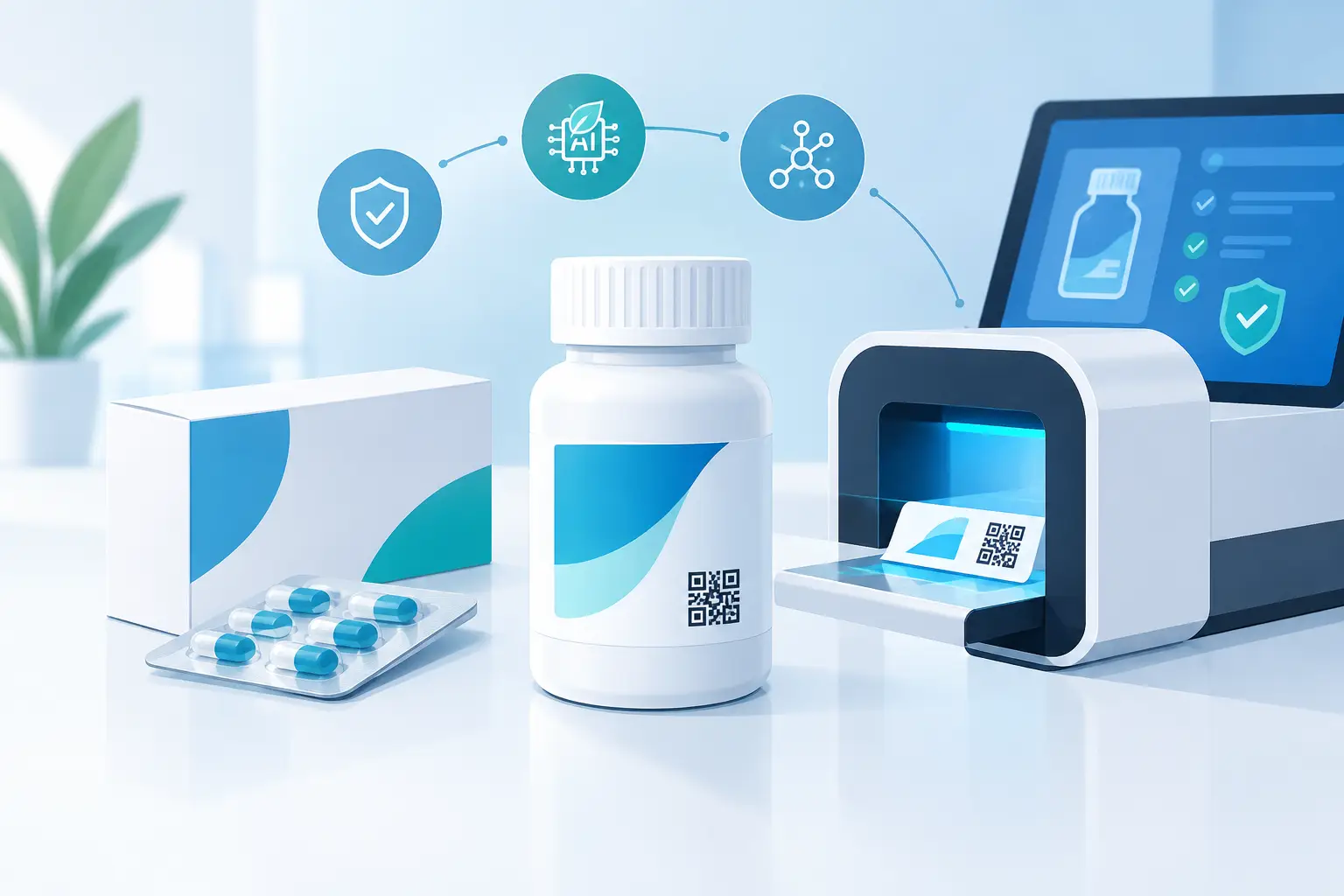
A label change that once involved a planned production run can now arrive with a tight deadline: updated safety language, a revised NDC presentation, a serialization requirement, or a new package configuration. The future of pharmaceutical labeling is being shaped by that operational reality. Pharmaceutical manufacturers need labels that do more than look accurate on press. They need to support compliance, traceability, patient safety, and efficient production without creating delays on the packaging line.
For packaging teams and procurement leaders, this shift changes what a dependable label supplier looks like. Print quality still matters, but so do material consistency, version control, color repeatability, fast response to artwork changes, and the ability to plan for a range of label formats and production volumes.
The Future of Pharmaceutical Labeling Is More Connected
Pharmaceutical labels are becoming a more active part of the product and its supply chain. The printed label remains the primary carrier of essential information such as product identification, dosage details, lot numbers, expiration dates, storage requirements, warnings, and barcodes. Increasingly, it must also work with digital systems that support inventory control, verification, recall response, and patient information.
Serialization and track-and-trace requirements have accelerated this need for accuracy. A barcode or variable data field that is difficult to scan, placed incorrectly, or printed with insufficient contrast can create problems far beyond the finished package. The label has to perform reliably through printing, application, distribution, and use.
This does not mean every pharmaceutical product needs the same advanced solution. A high-volume prescription product, an over-the-counter medicine, a clinical trial kit, and a topical health product can have very different requirements. The practical goal is to match the label construction and print process to the product’s regulatory, environmental, and operational needs.
Compliance Will Demand Better Change Control
Pharmaceutical labeling is never static. Regulatory updates, formula changes, revised warnings, new markets, and packaging redesigns all create artwork revisions. The challenge is not simply producing a corrected label. It is ensuring the correct version is released, printed, inspected, and delivered when needed.
Strong change control begins before the press runs. Packaging teams should define who approves artwork, how revisions are named, what files are production-ready, and how obsolete versions are removed from use. A clear approval path protects against costly mix-ups, especially when multiple SKUs have similar designs or when the only change is a small block of regulated text.
Digital label printing can be especially useful when pharmaceutical buyers need to manage shorter runs, multiple versions, or rapid changes. It reduces the burden associated with traditional setup for every variation and can support cost-effective production where versioning matters. However, speed should not replace review. The fastest turnaround is only valuable when the approved artwork, barcode specifications, and material requirements are clear from the start.
Legibility Is a Patient-Safety Requirement
Small type, tightly packed copy, and poor contrast are not minor design issues on a pharmaceutical label. They can affect how a pharmacist, clinician, caregiver, or patient reads critical information. As more products compete for limited package space, label design must balance brand presentation with legibility.
This is where production input is valuable early in the process. Type size, line spacing, color combinations, varnish choice, and label dimensions all affect readability. A design that looks clean on a screen may lose clarity when printed on a small vial, curved bottle, or flexible package.
When space is limited, a booklet label, extended-content label, or other multi-panel construction may be appropriate. These formats can provide room for instructions, multilingual content, warnings, or promotional copy while keeping core information accessible. They also require careful planning for application equipment, package shape, and end-user handling.
Materials Must Perform in Real Packaging Conditions
A pharmaceutical label can be perfectly printed and still fail if the adhesive or facestock is wrong for the application. Labels may encounter refrigeration, freezing, moisture, handling in clinical settings, sterilization processes, chemical exposure, or long storage periods. The container itself may be glass, HDPE, PET, polypropylene, foil, or another substrate with its own bonding characteristics.
Material selection should be based on the actual package environment, not just the appearance of a sample. For example, a label applied to a refrigerated vial may require a different adhesive than a label applied to a dry bottle at room temperature. A product exposed to oils, alcohols, or cleaning agents may need greater resistance to smearing or lifting. Clear labels, matte finishes, and specialty films can support the desired package appearance, but they should be evaluated for performance first.
The same principle applies to variable printing. Lot codes and expiration dates must remain readable and scannable throughout the product’s intended life. If thermal transfer overprinting, laser coding, or another variable-data method will be used after label production, the label surface must be compatible with that process.
Design for Application, Not Just Approval
A label’s journey does not end at quality approval. It still has to run efficiently on an applicator or be applied by hand without wrinkling, flagging, misalignment, or dispensing issues. Curved containers, small diameters, tapered bottles, and recessed panels all affect label behavior.
Early testing can prevent line problems later. Provide the label printer with container dimensions, application method, storage conditions, expected production speeds, and any special finishing requirements. If possible, test labels on the actual package and equipment before committing to a full production run. This is particularly important when changing substrates, adhesives, container suppliers, or application equipment.
Anti-Counterfeiting Features Will Become More Practical
Counterfeit products remain a serious concern in pharmaceutical distribution. Not every product needs highly complex security elements, but more brands are evaluating ways to make tampering, diversion, and imitation easier to identify.
Depending on the product and distribution risk, security measures may include serialized codes, tamper-evident label constructions, specialty inks, microtext, holographic components, or QR codes that direct users to authenticated product information. Each option has trade-offs. Some add cost, some require specialized inspection, and some are most effective when paired with broader supply-chain controls.
The key question is not which feature appears most advanced. It is whether the chosen approach can be produced consistently, verified in the field, and incorporated into normal packaging operations. A security feature that complicates application or cannot be reliably inspected may introduce more risk than it removes.
Digital Content Will Extend the Printed Label
The printed label will remain essential because it delivers regulated information directly on the package. At the same time, digital access points can give manufacturers more flexibility. A properly managed QR code can connect a package to medication guides, instructional videos, updated product information, refill support, or authentication tools.
This approach can help reduce pressure on limited label space, but it should be treated as an extension of the printed label, not a replacement for required on-package information. The code must be easy to scan, protected by sufficient contrast and quiet space, and governed through a process that keeps linked content current and secure.
For pharmaceutical companies, digital content also raises ownership questions. Who maintains the destination? Who approves changes? What happens if a product is discontinued or recalled? Those decisions belong in the packaging plan, not after labels have already been printed.
What Pharmaceutical Buyers Should Ask Before Printing
The most productive label projects begin with complete information. Before requesting a quote or approving a proof, packaging buyers should be ready to discuss the product container, label dimensions, artwork version, anticipated run size, application method, environmental exposure, variable data needs, and required delivery date.
It is also useful to identify which requirements are fixed and which are flexible. A specified label material may be mandatory because it has been validated for a particular use. In other cases, there may be room to consider a different stock, finish, or print approach that improves cost, lead time, or application performance. Knowing that distinction helps a printing partner recommend practical options without compromising the project.
A supplier with pharmaceutical labeling experience should ask detailed questions rather than assume that a visually similar label has the same requirements. The difference between a health and beauty label and a pharmaceutical label may be a few lines of text, a barcode standard, a cold-chain condition, or an approval process. Those details determine whether the finished label performs as intended.
Build Labeling Into the Packaging Plan Early
The future of pharmaceutical labeling will reward companies that treat labels as a production-critical component rather than a final packaging detail. Better planning gives teams more time to test materials, confirm artwork, prepare for revisions, and avoid preventable line interruptions.
At Miles Label Company, that means approaching each pharmaceutical label project with the production questions first: what the label needs to communicate, where it will be used, how it will be applied, and what it must withstand. When those answers are clear, the path to a dependable, high-quality label becomes much more straightforward.