
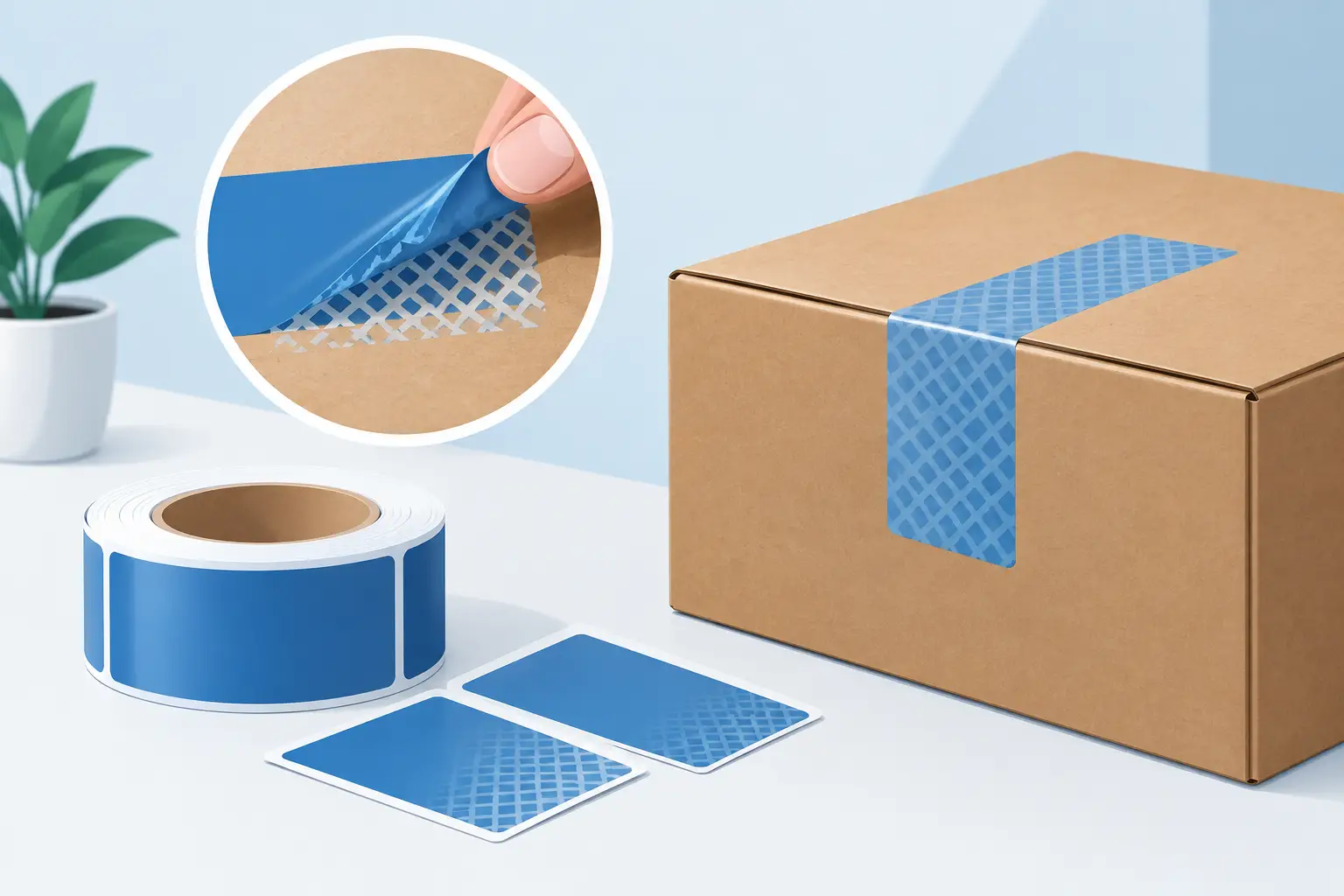
A broken seal can turn a routine receiving check into a product hold, customer complaint, or costly investigation. This guide to tamper evident labels helps packaging buyers select labels that provide a clear visual indication when a package has been opened, altered, or accessed after packing. The right solution protects more than the product inside. It supports consumer confidence, helps document quality controls, and gives operators a consistent way to inspect packaged goods.
Tamper evidence is not one material or one label format. A seal that performs well on a glass cosmetic jar may fail on a refrigerated food container, a powder-coated industrial enclosure, or a corrugated shipping carton. Package geometry, surface energy, storage temperature, adhesive selection, and how the customer opens the product all affect the final result.
What Tamper Evident Labels Are Designed to Do
Tamper evident labels are pressure-sensitive labels or seals designed to show visible evidence when someone tries to remove, lift, break, or reposition them. They do not physically prevent every attempt to open a package. Their job is to make interference apparent before a product is used or accepted.
That distinction matters during specification. If the product requires access control, child resistance, sterility protection, or theft deterrence, a tamper evident label may be one part of the packaging system rather than the complete answer. The label should work alongside the container, closure, carton, shrink band, and inspection process.
For many consumer products, the most effective application is a label that bridges the cap and container. Opening the closure breaks, tears, or distorts the label. For cartons and shipping cases, a seal may span the opening flap. For equipment, asset protection, or warranty applications, a destructible or residue-transfer construction can show that a panel has been accessed.
Choosing the Right Tamper Evident Label Construction
The best construction starts with the package and the expected failure mode. Ask a simple question: what should an inspector see if the package has been opened? The answer may be a torn strip, a checkerboard residue, a hidden VOID message, or a label that cannot be removed in one piece.
Destructible labels
Destructible films and papers are designed to fracture when removal is attempted. They are commonly used for warranty seals, electronics, industrial equipment, pharmaceutical secondary packaging, and other applications where a seal should not lift cleanly.
These labels can be highly effective, but they require a compatible surface. Rough textures, oily substrates, dust, and low-surface-energy plastics can reduce adhesion and allow pieces to lift. A label that breaks as intended on a smooth coated surface may perform differently on a molded polypropylene cap.
Void and residue-transfer labels
VOID labels leave a message, pattern, or adhesive residue on the package surface when removed. Some reveal the message on both the label and the package; others retain it primarily on the package. This provides a strong visual signal and can be useful for closures, cartons, equipment panels, and controlled-access applications.
Residue transfer should be selected carefully for retail packaging. It can be useful evidence of opening, but it may leave an appearance that a consumer sees as messy or difficult to remove. Consider whether the seal is intended to stay on the package after opening and whether residue is acceptable on the container material.
Tamper bands and closure seals
A closure seal typically extends from the cap or lid onto the bottle, jar, tube, or container body. When the consumer twists or lifts the closure, the seal tears. This is a familiar format for food, beverage, supplements, beauty products, and household goods.
Design details are critical. The seal must be wide enough to bridge the closure securely, yet positioned so it does not wrinkle around shoulders, ribs, seams, or curved surfaces. Perforations and engineered tear features can help create a controlled opening, but they also need to withstand filling, packing, and distribution before the consumer receives the product.
Tamper-evident carton and case seals
Carton seals show whether a folding carton, mailer, or corrugated case has been opened. They can carry branding, lot information, handling instructions, or inspection messaging while providing a visible closure point.
For corrugated packaging, adhesive selection is especially important. Recycled board, cold storage, and dusty warehouse conditions can all affect bond strength. A seal that is too aggressive may tear the carton so severely that normal opening becomes frustrating. A seal that is too weak can lift during transit. Production testing is the fastest way to find the right balance.
Material and Adhesive Decisions That Affect Performance
Print appearance gets attention early in a label project, but adhesive and facestock choices often determine whether a tamper-evident label works in the field. The label must bond to the actual package surface at the actual application temperature.
Paper constructions can be cost-effective for dry, indoor products and cartons. Film materials often provide better resistance to moisture, oils, scuffing, and refrigeration. Clear films can preserve a product’s package design, while white films create stronger opacity and print contrast. For products exposed to chemicals, abrasion, outdoor conditions, or repeated handling, a more durable film and protective finish may be necessary.
Adhesive choice depends on the substrate and environment. Glass, metal, coated cartons, polyethylene, polypropylene, and powder-coated surfaces each present different bonding challenges. Cold-temperature adhesives may be needed when labels are applied or stored in refrigerated conditions. Aggressive permanent adhesives may be appropriate for textured or difficult surfaces, but they should be tested to ensure removal produces the intended evidence.
Keep in mind that adhesion develops over time. A label may feel secure immediately after application but reach its intended bond after 24 to 72 hours. Testing only minutes after application can lead to the wrong conclusion.
Design a Seal That Supports Inspection
A tamper-evident label should make inspection quick. If a receiver, retailer, or consumer cannot tell whether it has been disturbed, the seal is not doing its job.
Use clear visual cues. A contrasting color band, a repeating security pattern, a visible tear line, or straightforward text such as “Sealed for Your Protection” can help establish what an intact package should look like. If a hidden message is revealed after removal, make sure it is large enough to be noticed without special training.
Variable data can add operational value. Lot numbers, production dates, serial numbers, QR codes, and sequential numbering can help manufacturers trace packages and investigate issues. These features should be considered separately from the tamper function. A printed serial number helps identify a unit, but it does not make a standard label tamper evident on its own.
Avoid placing critical tamper indicators under heavy graphics, metallic effects, or copy that makes damage hard to see. A clean security area is often more useful than a complex design. For regulated categories, confirm that required information remains legible after the package is opened or the seal is broken.
Test Labels on the Actual Packaging Line
A tamper-evident label should be tested on real packages, not only evaluated from a material data sheet. Apply production-like samples to filled containers or assembled cartons and allow adequate dwell time. Then test the conditions the product will actually encounter: vibration, compression, refrigeration, humidity, warehouse storage, and normal consumer opening.
Evaluate more than adhesion. Check whether labels wrinkle on application, bridge closures consistently, tear where intended, and remain readable after handling. Review what happens when a seal is removed slowly, quickly, at an angle, or after exposure to heat and cold. It is also useful to test a second opening attempt to confirm the package cannot be made to look unopened again.
Document the approved label construction, application position, and inspection criteria. This gives production teams a clear standard and makes repeat orders more consistent. If the package, closure supplier, coating, or filling conditions change, repeat the evaluation rather than assuming the existing label will perform the same way.
Common Specification Mistakes to Avoid
The most common mistake is selecting a security feature before defining the package environment. Another is assuming that a permanent adhesive automatically creates tamper evidence. A permanent label can still be removed cleanly from certain surfaces if the facestock and adhesive are not engineered for destruction or message transfer.
Buyers also sometimes overlook label dispensing requirements. A very aggressive adhesive, thin destructible material, or narrow die-cut shape may need special attention on high-speed equipment. Label applicator settings, release liner selection, and label orientation can affect throughput and waste rates.
Finally, do not treat the label as an afterthought once a package design is complete. A small change in cap height, bottle shoulder shape, varnish, or carton coating can change how a seal applies and fails. Bring the label printer into the planning process early enough to recommend materials, produce samples, and identify practical production risks.
Work With a Printer That Can Build for the Application
Tamper-evident labels need to meet brand, production, and security requirements at the same time. An experienced label manufacturer can help compare constructions, confirm print and finishing options, and plan a sample run before full production. For brands with multiple SKUs, digital printing can also support shorter runs, version changes, and variable information without sacrificing print quality.
Miles Label Company works with packaging buyers across food, beverage, health and beauty, pharmaceutical, and industrial applications to produce labels built around real operating conditions. Share the package material, closure style, application method, storage environment, and desired tamper indication early in the quoting process. A well-tested seal gives your team a clear standard to inspect and your customers a clear reason to trust the package in their hands.