
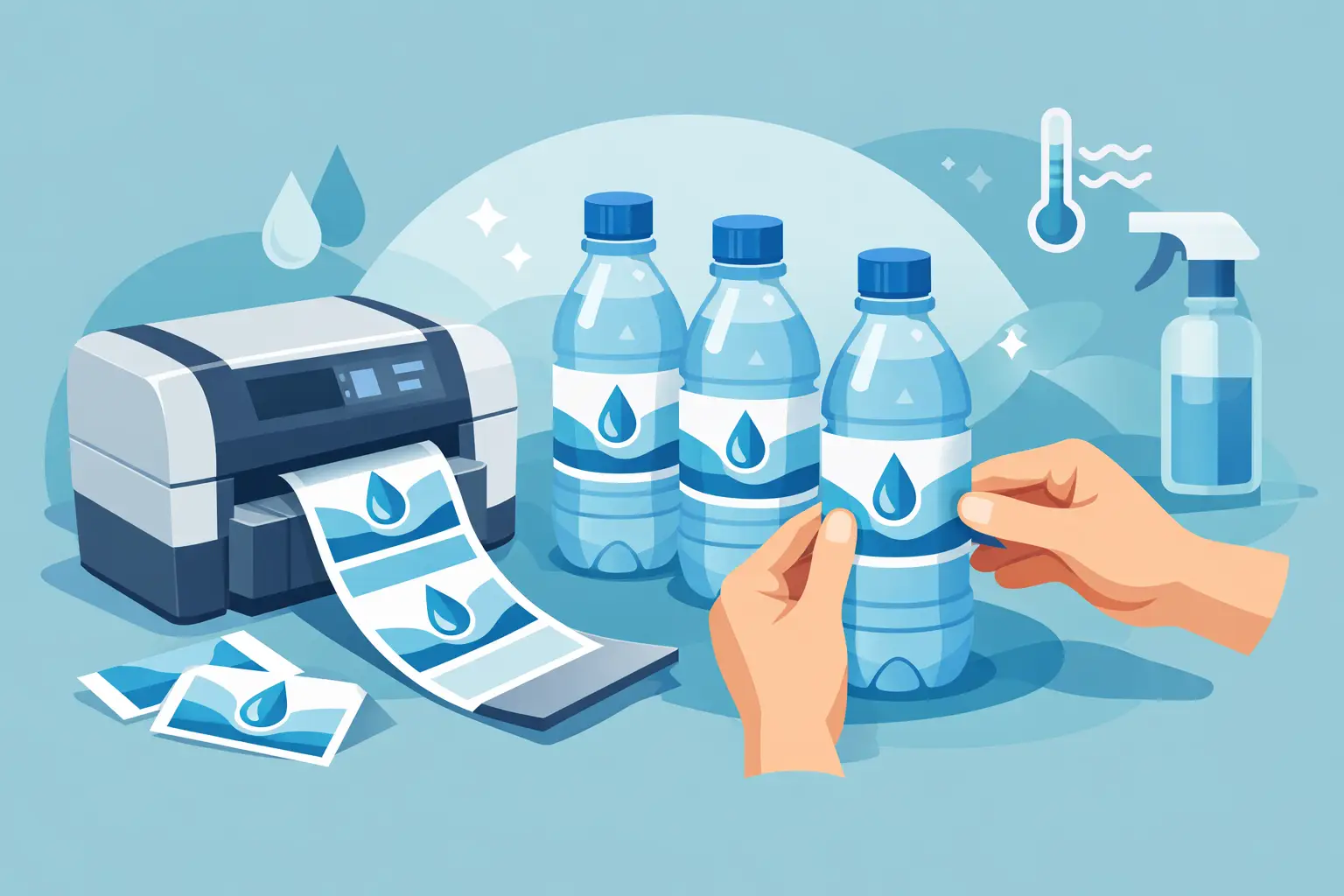
A water bottle label may look simple on the shelf, but it has to perform through filling, chilling, shipping, handling, and condensation. Knowing how to print water bottle labels means planning for that entire process, not simply choosing an attractive design. The right material, adhesive, print method, and file setup help ensure every bottle leaves the line looking consistent and stays that way in the customer’s hand.
For bottled water brands, co-packers, and packaging buyers, the best label is the one that protects the brand while fitting the realities of production. That starts with a few decisions made before the press runs.
Start With the Bottle and Its Environment
The bottle itself determines many label specifications. A label that works on a smooth PET bottle may not perform the same way on a contoured HDPE bottle, a reusable aluminum container, or a glass bottle placed in an ice-filled cooler.
Begin by documenting the bottle material, shape, circumference, label panel dimensions, and filling conditions. A tapered bottle needs a label designed for that taper. If the label is too wide or the artwork is built as though it will sit on a straight wall, wrinkles and edge lift can occur during application. Bottles with deep ribs, raised graphics, or uneven surfaces also require extra consideration because the label must conform around those features.
Next, consider where the finished product will go. Room-temperature bottles have different needs than bottles that move immediately into refrigerated storage. Water bottles exposed to condensation, ice chests, or repeated handling need materials and adhesives that hold up to moisture. A label that looks excellent when dry but turns cloudy, scuffs, or releases at the edge after chilling is not production-ready.
Choose a Label Material Built for Moisture
Paper can be appropriate for some beverage applications, but most single-use water bottles require a film label. Film materials are more resistant to water, tearing, and handling than standard paper stocks. They also provide a clean, premium appearance when paired with the right finish.
Common options include white polypropylene film, clear polypropylene film, and specialty films selected for specific bottle materials or application equipment. White film provides an opaque base for bright colors and readable type. Clear film can create a no-label look, where graphics appear to print directly onto the bottle. This can be effective for premium water brands, but it requires careful artwork preparation because white ink, transparency, and bottle color affect the final appearance.
Material selection is not only an aesthetic choice. Clear labels can show air bubbles or application flaws more readily than opaque labels. Metallic effects, soft-touch finishes, and highly transparent films can add shelf impact, but may add cost or introduce additional production variables. The best choice is the one that supports the brand position without compromising application speed or durability.
Match the Adhesive to Filling and Storage Conditions
The adhesive is what keeps a water bottle label in place when the bottle sweats, travels through distribution, and reaches a refrigerator or cooler. It should be selected based on both the bottle surface and the temperatures involved in labeling and storage.
A standard permanent adhesive may work for dry application to clean PET bottles. However, cold bottles, wet-fill conditions, low-temperature labeling, or heavy condensation may require a more specialized adhesive. If labels are applied after the bottles have been chilled, the adhesive must be designed to bond at lower temperatures. If bottles are labeled before filling, the adhesive must withstand the conditions that follow.
Do not assume a label adhesive is universal. Bottle resin, surface treatment, label application temperature, and refrigeration cycles can all affect performance. A production partner should ask about these conditions before recommending a construction. Testing on actual bottles is the most reliable way to confirm the specification.
How to Print Water Bottle Labels With Press-Ready Artwork
Good printing begins with a complete, press-ready file. Water bottle labels are often small, which makes type size, barcode placement, and color control especially important. A well-designed label can still fail if the production file is missing bleed, uses low-resolution images, or places critical elements too close to the trim edge.
Build the artwork at the final label size and include the required bleed around the outside edge. Keep logos, small copy, nutrition information, lot-code areas, and other critical content inside a safe margin. This accounts for normal trim and application tolerances.
Use high-resolution images and vector artwork whenever possible. Vector logos and type remain crisp at any size, while low-resolution raster images can appear soft or pixelated in print. Convert or define colors carefully, particularly when brand colors must remain consistent across multiple production runs.
Barcodes need their own quality check. Leave adequate quiet zones around the code, avoid placing it over busy graphics, and use a color combination that scans reliably. Black bars on a white background remain the simplest option. If a barcode will be scanned through a clear label or printed over a colored bottle, test the finished package rather than relying only on the digital file.
For regulated or retail-ready bottled water, review all required product information before approval. Depending on the product and market, that may include the brand name, net contents, ingredient or source information, distributor details, nutrition facts, recycling marks, and lot or date coding space. Label printing supports compliance, but the brand remains responsible for confirming that its final content meets applicable requirements.
Select the Right Print Method and Finish
Digital label printing is a strong fit for many water bottle programs because it delivers high-quality color, fast turnaround, and efficient short-to-medium runs. It is especially useful for seasonal artwork, promotional versions, regional branding, or multiple SKU variations. Modern digital presses can reproduce detailed graphics, fine type, and variable information without the setup requirements associated with some conventional processes.
For higher-volume, repeat programs, the best production approach depends on run size, material, number of versions, and finishing requirements. A capable label manufacturer can review those variables and recommend the most cost-effective path instead of forcing every job into one process.
Finish also affects both appearance and performance. A gloss finish can make water imagery and color photography stand out. Matte finishes offer a more understated, premium look and can reduce glare. A protective varnish or laminate can improve scuff resistance during transport and retail handling. The trade-off is that certain finishes may change the feel, cost, or recyclability profile of the label package.
When a label will be handled heavily in coolers, shipped in trays, or displayed in high-traffic environments, ask for a recommendation based on real-world use. The right finish should support the product’s journey, not only its appearance during an approval meeting.
Plan for Application Before You Order
A label is only as good as its performance on the application line. Before placing an order, confirm whether labels will be applied by hand or by automated equipment. Machine-applied labels require specifications that match the applicator, including roll direction, unwind orientation, core size, maximum roll diameter, gap between labels, and label placement requirements.
Small differences in roll configuration can slow a line or cause avoidable downtime. If an applicator pulls labels from the roll in a particular direction, the label printer needs that information before production. The same is true for bottles that use front-and-back labels, wrap labels, tamper-evident bands, or labels with variable data.
Hand application allows more flexibility but still benefits from consistent label dimensions and adhesive performance. For small brands or test launches, a shorter digital run can provide a practical way to validate the design on actual bottles before committing to a larger production order.
Approve a Proof and Test the Finished Package
A digital proof is useful for reviewing copy, positioning, and general design, but it cannot fully replicate how a label behaves on a filled bottle. For best results, review a physical sample on the actual container whenever possible.
Check the label under normal warehouse and retail lighting. Then test it after refrigeration and exposure to condensation. Look for lifting edges, bubbles, wrinkling, ink scuffing, poor barcode scanning, and readability issues. If the bottles are packed in cases or trays, inspect the labels after transport testing as well.
This step may add time before the first production run, but it prevents a far more expensive problem after labels have been printed and applied. A dependable supplier will treat testing as part of the planning process, particularly when a project involves a new bottle, a new material, or demanding storage conditions.
Work With a Label Partner That Understands Production
Water bottle labels bring together branding, materials science, regulatory content, and line efficiency. That is why a custom quote should account for more than label size and quantity. The most useful conversation includes bottle details, artwork, application method, production schedule, storage conditions, and the visual result the brand needs to achieve.
Miles Label Company helps brands evaluate those details with experienced guidance, high-quality digital printing, and production-focused support. Whether the job is a startup launch, a promotional run, or a repeat beverage program, clear specifications at the beginning lead to better labels at the end.
The practical goal is straightforward: print a label that applies cleanly, remains readable in cold and wet conditions, and represents the product with confidence wherever it is sold.