
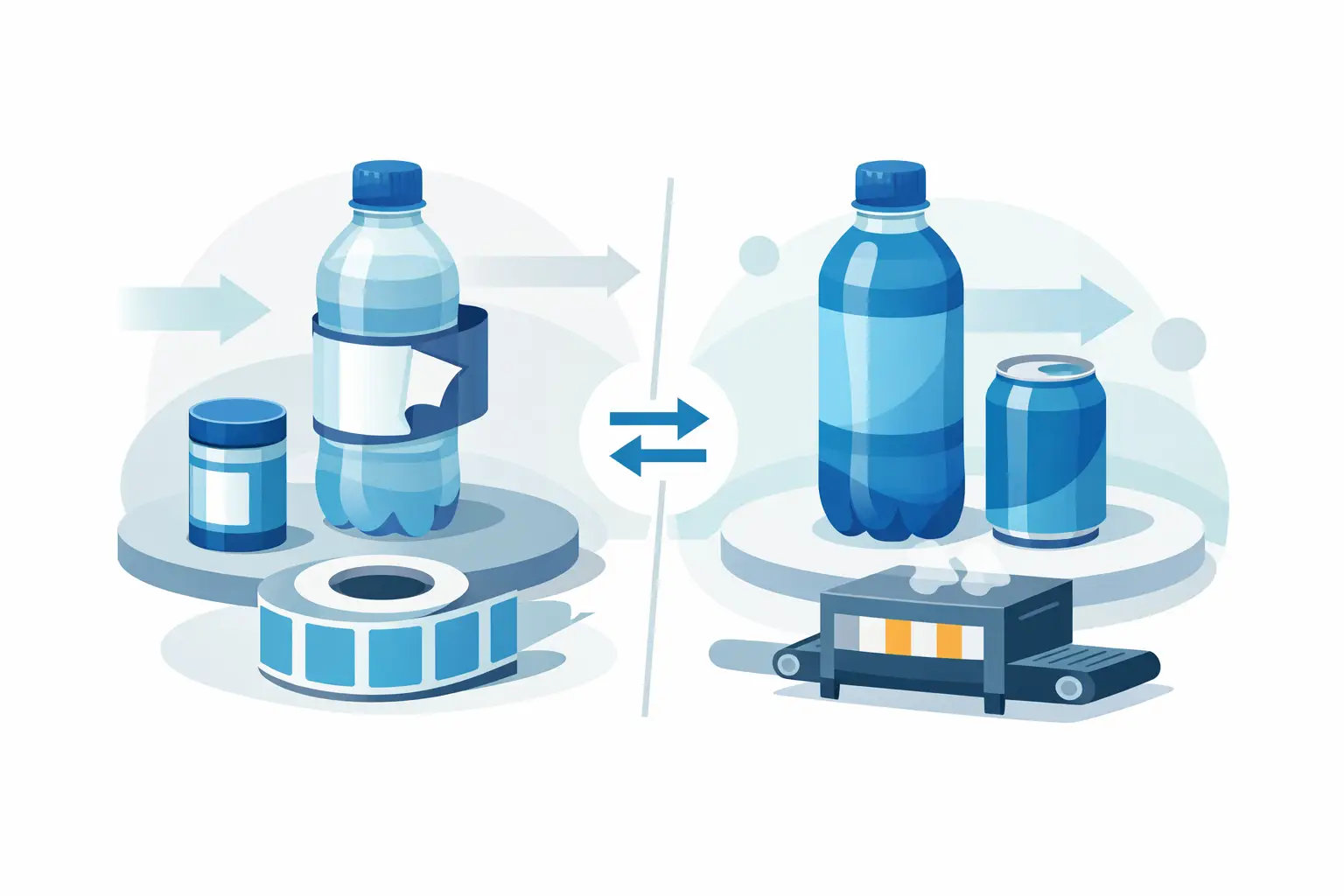
A label choice can affect far more than shelf appearance. It influences container selection, line equipment, production costs, lead times, and how easily a product can be updated later. When comparing pressure sensitive vs shrink sleeves, the right answer depends on the package shape, sales channel, product environment, and the level of brand coverage the container needs.
Pressure-sensitive labels are a proven fit for many packaged goods because they are efficient, versatile, and available in materials suited to food, beverage, health and beauty, pharmaceutical, and industrial applications. Shrink sleeves offer a different advantage: near-total package decoration, including highly contoured bottles and containers that standard labels may not cover effectively.
Pressure Sensitive vs Shrink Sleeves: The Core Difference
A pressure-sensitive label is an adhesive-backed label applied directly to a container. It is supplied on a liner or linerless construction, depending on the application, and adheres when pressure is applied. The label can be paper, film, foil, or another specialized material selected for the product’s use conditions.
A shrink sleeve is a printed plastic film tube or band placed around a container and exposed to heat. The film contracts to conform to the package. Full-body shrink sleeves can cover nearly the entire container, while tamper-evident shrink bands are commonly used around caps and closures.
The distinction matters because each format has different production requirements. Pressure-sensitive labels generally work with standard label applicators and do not require a heat tunnel. Shrink sleeves require sleeve application equipment and controlled heat shrinking, which adds equipment, process validation, and quality-control considerations.
When Pressure-Sensitive Labels Make More Sense
Pressure-sensitive labels are often the practical choice for brands that need strong visual impact without changing their filling or packaging line. They can be produced in many shapes and sizes, including front-and-back labels, wraparound labels, neck labels, and small-format labels for jars, bottles, pouches, and cartons.
They are particularly effective on containers with a consistent labeling panel. A cylindrical beverage bottle, straight-sided jar, cosmetic tube, or industrial container can carry a pressure-sensitive label cleanly and reliably when the label material and adhesive are matched to the surface and environment.
For many operations, speed and flexibility are the deciding factors. A brand can revise an ingredient panel, add a promotional callout, update a UPC, or introduce a limited-edition design without committing to a new decorated container. This is valuable for products with seasonal artwork, frequent compliance changes, or multiple SKUs in shorter runs.
Pressure-sensitive materials also provide options for demanding environments. Film labels can withstand moisture and handling better than many paper constructions. Specialty adhesives can be selected for refrigeration, freezer exposure, curved surfaces, textured containers, or oil and chemical contact. The right material is not simply a design decision. It must perform through filling, distribution, retail display, and customer use.
Benefits for production planning
Pressure-sensitive labels typically offer a lower barrier to entry for brands that already use label applicators. They can support a broad range of order quantities and are often more economical than shrink sleeves when full-container coverage is not necessary.
They also simplify artwork planning. Designers do not usually need to account for extensive shrink distortion, although curved containers still require careful layout and proofing. Critical copy, barcodes, nutrition panels, and warning statements can be placed in predictable areas of the label.
That does not mean pressure-sensitive labels are always the least expensive option. Large labels, premium films, specialty finishes, multiple application panels, and complex die cuts can add cost. However, the total packaging system is often simpler than a sleeve-based process.
Where Shrink Sleeves Have an Advantage
Shrink sleeves are designed for visual coverage and container conformity. They are especially useful when a package has an hourglass profile, deep contours, molded grips, or an irregular shape with no dependable flat labeling area. Instead of designing around a small label panel, the brand can use the container itself as a 360-degree billboard.
This format is common for beverages, nutritional products, sauces, personal care containers, household products, and promotional packaging. A full-body sleeve can hide a less attractive container, create a premium printed appearance, and provide ample room for brand graphics and required information.
Shrink sleeves can also combine decoration with tamper evidence. A sleeve that extends over the cap and neck may visibly show whether the package has been opened. For products where tamper evidence is required or strongly expected, this can be an operational advantage. The final package still needs to meet applicable regulations and product-specific requirements.
The trade-offs behind full coverage
The same coverage that makes shrink sleeves appealing also makes them more complex. Sleeve artwork must be engineered for distortion. Areas of the design will shrink at different rates as the film conforms to the container, so logos, type, barcodes, and regulatory copy require intentional placement. A design that looks correct on a flat file can look stretched or compressed on the finished container.
Heat application must also be controlled. Inconsistent steam or heat-tunnel conditions can create wrinkles, incomplete shrinkage, distortion, or misalignment. This is manageable with the right equipment and process controls, but it should be considered before selecting the format.
Shrink sleeves may also affect recycling decisions. Because the sleeve film and container can be different materials, recyclability can depend on local collection systems, sleeve construction, perforations, and whether consumers remove the sleeve. Brands with sustainability goals should evaluate the entire package, not just the printed component.
Compare Cost Beyond the Price Per Label
A fair cost comparison includes more than the unit price of printed labels or sleeves. Pressure-sensitive labels may require a compatible applicator, but many manufacturers already operate this equipment. Shrink sleeves require applicators, heat tunnels, and more production oversight, particularly for full-body applications.
Container costs matter as well. A shrink sleeve can allow a brand to use a standard stock bottle while achieving a fully decorated appearance. In some cases, that can offset sleeve complexity. In other cases, a pressure-sensitive label on a well-designed stock container delivers the needed shelf presence at a more controlled total cost.
Order volume changes the equation. Higher-volume programs can justify dedicated sleeve equipment and extensive setup work. Smaller runs, market tests, regional launches, and frequently changing artwork often favor pressure-sensitive labels because they are easier to revise and manage across multiple SKUs.
Match the Format to the Product Environment
The product’s real-world conditions should guide material selection. A water bottle placed in an ice chest needs a label construction that handles condensation. A frozen food product needs an adhesive designed for low temperatures. A personal care product used in a shower needs moisture-resistant materials and inks. An industrial chemical container may require durability, chemical resistance, and legible safety information throughout its service life.
Shrink sleeves can provide excellent coverage in wet environments, but they are not automatically the better durability choice. Film type, ink system, finish, application conditions, and the container all influence performance. Likewise, a properly specified film pressure-sensitive label can perform exceptionally well in moisture-heavy or high-contact applications.
For regulated products, label format must also support readable, durable information. Pharmaceutical, food, and chemical labels may need lot codes, warnings, ingredients, directions, barcodes, and other required copy. The decoration format should leave room for this information without making the package difficult to scan or read.
Questions to Settle Before You Quote
Before requesting pricing, define the container dimensions and material, labeling panel, fill temperature, storage conditions, expected handling, and annual volume. It also helps to identify whether the design needs full-body graphics, tamper evidence, variable information, metallic effects, tactile finishes, or frequent artwork changes.
Bring a physical container to the discussion whenever possible. A label supplier can evaluate curves, seams, recessed panels, and application challenges that may not be apparent in a drawing. Early review also prevents a common mistake: finalizing artwork before confirming that the selected format can apply cleanly and perform as intended.
Miles Label Company helps brands evaluate pressure-sensitive label materials, adhesives, finishes, and print approaches based on the actual packaging application. For projects requiring sleeve packaging, the same production-first questions apply: confirm the container, application equipment, artwork distortion requirements, and finished-package expectations before committing to the format.
The best package is not the one with the most coverage or the lowest unit price. It is the one that protects the product, presents the brand clearly, runs reliably on the line, and gives your team room to grow without creating avoidable packaging problems later.