
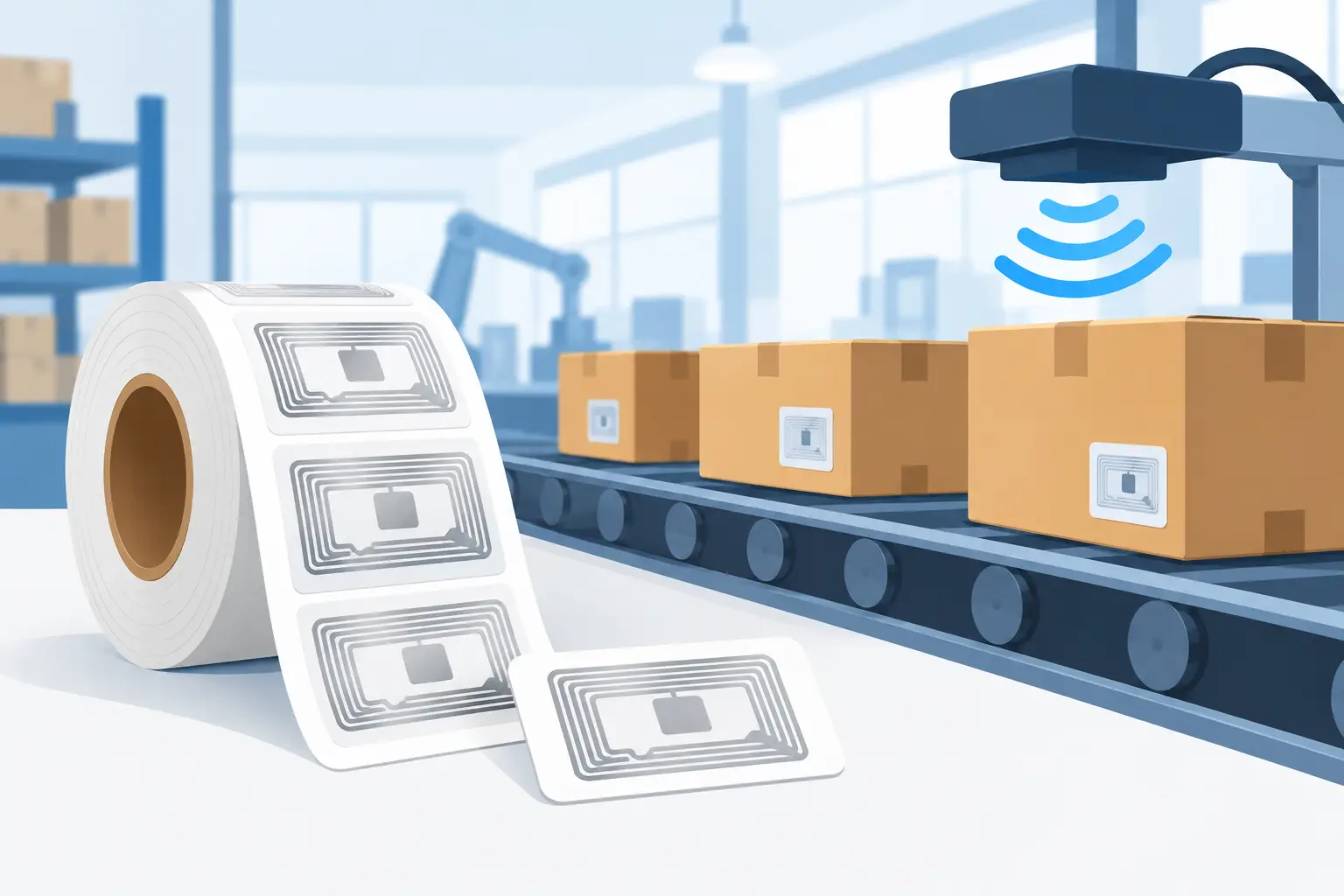
A case of products can look identical on a pallet, yet each unit may need its own digital identity. RFID labels make that possible without requiring employees to scan every barcode one at a time. For manufacturers, brand owners, and packaging teams, the value is practical: better inventory visibility, faster receiving, more reliable traceability, and fewer manual touchpoints in the supply chain.
The label itself is only part of the solution. An RFID project succeeds when the tag design, label material, adhesive, print requirements, application method, and reading environment are considered together. A label that performs well on a dry corrugated case may fail on a curved bottle, a metal container, or a product exposed to heat, moisture, or cold storage.
What Are RFID Labels?
RFID labels are pressure-sensitive labels that contain an RFID inlay: a small antenna and integrated circuit embedded within the label construction. The chip stores a unique identifier and, depending on the system, may carry additional data. When an RFID reader emits radio-frequency energy, compatible labels within range can respond without a direct line of sight.
Most packaging and inventory applications use passive RFID labels. These labels do not contain a battery. They receive power from the reader signal, which keeps the label thin, cost-effective, and suitable for high-volume use. Active RFID tags include a battery and can be read at greater distances, but they are generally larger and intended for different asset-tracking applications.
Unlike a standard printed label, an RFID label has two jobs. It must communicate electronically with readers, and it must still function as a physical package label. That means it may need sharp product graphics, readable variable data, durable adhesion, regulatory text, and a finish that fits the brand’s packaging requirements.
Where RFID Labels Deliver Value
RFID is not necessary for every product or every operation. Traditional barcodes remain a dependable, economical choice when a worker can scan one item at a time and basic identification is enough. RFID becomes more compelling when businesses need to identify many items quickly, improve inventory accuracy, or reduce manual scanning at key handoff points.
Common uses include case and pallet tracking, warehouse receiving, work-in-process identification, returnable container management, retail inventory, pharmaceutical and medical supply chain controls, and industrial asset identification. A distributor receiving a mixed shipment can read multiple tagged cases quickly. A manufacturer can confirm that the right components moved to the right production area. A brand can improve visibility into finished goods as they move through distribution.
The benefit depends on process design. RFID does not correct inaccurate master data or replace disciplined inventory procedures. It can, however, capture data faster and with less reliance on manual scans. That gives operations teams more timely information for replenishment, cycle counts, shipment verification, and exception management.
Selecting the Right RFID Label Construction
An RFID label should be specified for its real environment, not just its intended appearance. The first decision is usually the RFID frequency and protocol required by the customer, retailer, warehouse, or internal system. Ultra-high frequency, or UHF, RFID is widely used for supply chain and inventory applications because it supports longer read ranges and bulk reading. Other applications may require high frequency, near-field communication, or a specialized tag format.
Once the RFID platform is defined, the physical label construction matters just as much. The facestock may be paper, polypropylene, polyester, or another film selected for the package surface and expected handling conditions. Paper can be a practical choice for dry indoor applications. Film materials are often better suited to moisture, oils, abrasion, refrigeration, or demanding industrial environments.
Adhesive selection requires the same care. A permanent adhesive may be appropriate for a corrugated shipping case, while a freezer-grade adhesive may be needed for cold storage. Labels applied to rough surfaces, low-energy plastics, curved containers, or products with condensation need testing before a full production run. The wrong adhesive can create lifting edges, poor bond strength, or lost tags after application.
Product Material Can Affect Read Performance
RF energy does not behave the same around every product. Metal and liquid are the two most common complications. Metal can detune an antenna or reflect signals in ways that reduce readability. Liquid-heavy products can absorb RF energy and limit read range. Products such as canned goods, beverage bottles, chemical containers, and cosmetic packaging often require careful inlay placement and testing.
Placement is not an afterthought. A tag that works on the front panel of a carton may not perform when wrapped around a bottle or placed near a foil seal. The orientation of the label relative to the reader can also change results. Testing representative samples in the actual reading environment is the practical way to validate performance.
Printing, Encoding, and Verification
RFID labels often need conventional printed information alongside the encoded chip data. This can include branding, product names, UPC barcodes, lot numbers, expiration dates, serial numbers, handling instructions, and compliance copy. The printed design must account for the inlay location so critical graphics, text, and barcodes do not fall over areas that can affect appearance or application.
Encoding assigns the correct electronic data to each RFID chip. In a serialized application, each label receives a unique identifier. The data format must match the requirements of the customer’s software, warehouse system, trading partner, or industry standard. A label can look perfect and still fail operationally if the encoded data is incorrect or the chip does not respond as required.
Verification should be built into the production plan. A proper RFID label workflow checks that the chip is encoded, that the tag can be read, and that the printed variable information matches the intended record. Some applications also require inspection for barcode quality, print legibility, and label placement. For regulated products, this level of control supports traceability and helps reduce the risk of product identification errors.
Balance Read Range With the Application
Longer read range is not always better. In a busy warehouse, a tag with excessive sensitivity may be read from an adjacent pallet or nearby staging area. In other applications, limited read range is a problem because operators need to capture labels through cases, at dock doors, or while products move on conveyors.
The right choice is based on the process. Define where the label will be read, how many tagged items may be present, what materials surround the product, and how quickly products move. Those details help determine the appropriate inlay, placement, reader configuration, and test plan.
Planning an RFID Label Project Before Production
A productive conversation with a label manufacturer starts with the application, not only the label dimensions. Provide the package type, application surface, expected temperature range, exposure to moisture or chemicals, quantity requirements, and whether labels will be applied by hand or machine. Also identify the RFID standard, the data to be encoded, the reading distance required, and any retailer or customer specifications.
Artwork should be reviewed with both print and RFID performance in mind. Variable-data fields need enough space and contrast for reliable scanning. If a barcode is required, its size, quiet zones, and placement should be protected. Brand graphics still matter, especially for consumer-facing packaging, but they should not create production challenges around the inlay or interfere with required information.
A pilot run is often worthwhile before scaling a new program. It allows the team to test adhesion, read performance, print quality, application equipment, and system integration using real product samples. This step can prevent a costly issue from reaching the warehouse or a customer distribution center.
Miles Label Company approaches specialized label work as a production requirement, not a generic product selection. With the right specifications established early, a custom RFID label program can support fast turnaround, consistent print quality, and repeatable performance across future runs.
When RFID Labels Are the Right Investment
RFID labels are most useful when the cost of limited visibility exceeds the added cost of tagging. For a low-volume product handled manually, a printed barcode may be the sensible answer. For operations managing high item counts, frequent inventory movements, customer compliance mandates, or serialized traceability, RFID can provide measurable operational value.
The strongest programs begin with a clear use case: verify outbound shipments, speed receiving, track reusable assets, improve inventory counts, or identify product at the unit level. From there, the label can be engineered around the product and process rather than forced into a one-size-fits-all format.
Bring package samples, environmental details, and system requirements into the quoting stage. The more accurately the label is specified before production, the more reliably it can perform when it matters on the line, in the warehouse, and at the point of delivery.