
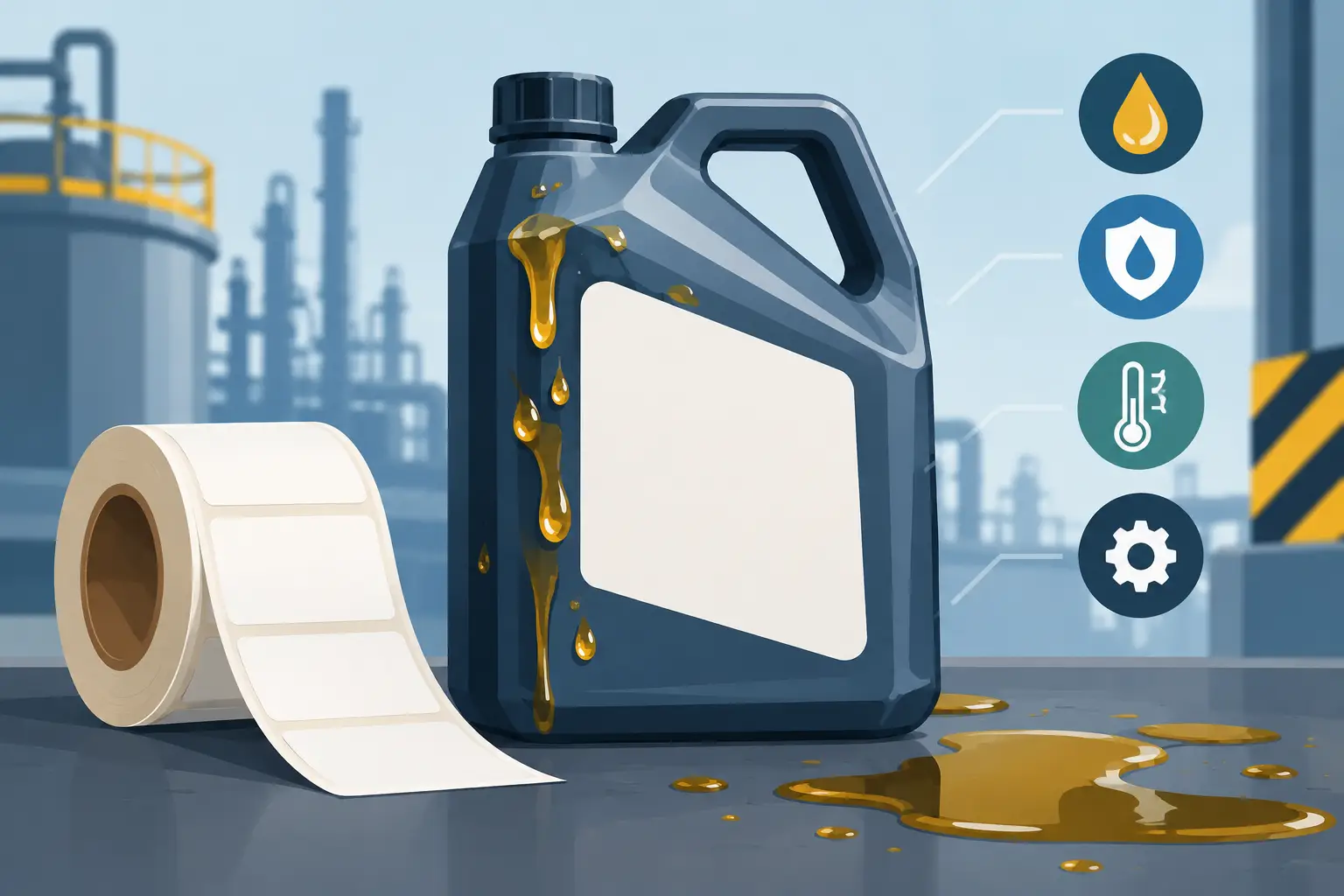
A label can look excellent when it leaves the production line and still fail before the product reaches the customer. Oil exposure can stain paper facestocks, weaken adhesives, blur printed graphics, and lift label edges. To select labels for oil resistance, buyers need to evaluate the full packaging environment, not simply request a “waterproof” or “durable” label.
For motor oils, lubricants, cooking oils, cosmetics, and industrial chemicals, label performance depends on the product formula, the container surface, how the package is handled, and how long it must remain legible. The right construction protects brand presentation while keeping required product information attached and readable.
Why Oil Resistance Requires a Complete Label Construction
Oil resistance is not a single material feature. A label consists of a facestock, adhesive, ink system, coating or laminate, and release liner. Each component affects how the finished label performs when exposed to oils, greases, or oily hands.
An oil-resistant top coating may protect printed graphics from smearing, but it cannot compensate for an adhesive that softens when it contacts the product. Likewise, a high-performance adhesive will not prevent a paper label face from absorbing oil and showing dark, uneven staining. The construction must be specified as a system.
The first question is also the most practical: What kind of oil will contact the label? Vegetable oil, petroleum-based lubricant, essential oils, silicone oils, and cosmetic formulations can behave differently. Some remain on the label surface, while others migrate into the adhesive edge or attack particular coatings over time. A sample test using the actual filled package is often the most reliable way to confirm performance.
Start With the Exposure Conditions
Before selecting materials, define when and how the label will be exposed. A bottle of salad dressing handled occasionally at room temperature has different requirements than a lubricant container stored in a hot warehouse, used in a shop, and wiped repeatedly with oily rags.
Consider the expected exposure during filling, transport, retail handling, and end use. Is the container likely to be coated with product residue before labeling? Will the label face come into contact with drips, grease, or cleaning chemicals? Does the package need to withstand refrigeration, heat, moisture, abrasion, or UV exposure in addition to oil?
Duration matters as much as contact. Brief splashes can be less demanding than continuous contact or long-term storage in an oily environment. A label that survives a short handling test may still curl or discolor after several months on a warehouse shelf.
Define the oil and product formula
Provide as much information as possible about the product contents. The product safety data sheet, ingredient list, pH range, and information about solvents or additives can help identify likely compatibility concerns. For food and beauty products, fragrance oils and essential oils deserve particular attention because they can be aggressive toward certain adhesives and coatings.
If the label will be used on an industrial fluid, identify whether the product contains petroleum distillates, solvents, anti-wear additives, or other components that may migrate around the closure or onto the container exterior. The more specific the information, the more accurately a label supplier can recommend materials and testing.
Account for heat, cold, and handling
Oil resistance should not be evaluated in isolation. Heat can reduce adhesive strength, especially when combined with oil contamination at the label edge. Cold storage may affect application performance if labels are applied after containers have been chilled. Repeated squeezing, scuffing, and wiping can wear through an unprotected printed surface.
A container used in a garage, kitchen, manufacturing floor, or salon may face all of these conditions. Build the actual use environment into the specification rather than selecting a label based on a single property.
Select Labels for Oil Resistance by Material Type
Film labels are often the preferred starting point for oily applications. Polypropylene, polyethylene, and polyester films do not absorb oil the way uncoated paper does, which helps preserve a clean appearance. The best choice depends on the container, application method, stiffness requirements, and exposure level.
Polypropylene is a common option for consumer products because it provides a smooth printable surface and can deliver a premium appearance with clear, white, or metallic treatments. It works well for many food, health and beauty, and household product applications when paired with the correct adhesive and protective finish.
Polyethylene is more flexible and can be a better match for squeezable bottles. Its ability to conform to curved, flexible packaging helps reduce wrinkling and edge lift. That flexibility can be particularly useful for oils, sauces, lotions, and similar products packaged in soft plastic containers.
Polyester is generally chosen when higher durability, chemical resistance, or dimensional stability is needed. It is frequently considered for industrial and demanding applications, although its stiffness may not be ideal for every bottle shape or flexible package.
Paper labels can still be appropriate when the product environment is controlled and oil contact is unlikely. They may be a cost-effective option for certain dry-goods or secondary packaging applications. However, if oil can reach the label face or edges, a film construction usually offers greater protection and more consistent shelf appearance.
Match the Adhesive to the Container and Application
A label can fail even when the face material is oil resistant. Adhesive selection must account for the substrate, surface energy, label application temperature, and possible product contamination.
Glass and metal containers often provide reliable adhesion surfaces, provided they are clean and dry at application. Plastic containers require closer evaluation. High-density polyethylene and polypropylene are common for oils, lubricants, and personal care products, but their low surface energy can make adhesion more challenging. An adhesive formulated for difficult plastics may be needed to maintain long-term bond strength.
Application conditions should be documented early. Labels applied to a clean, dry container at room temperature have different adhesive needs than labels applied in a cold facility or to bottles that may have trace oil on the exterior. No pressure-sensitive label should be expected to perform consistently on heavily contaminated packaging. Improving container cleanliness before application can prevent costly rework and label loss.
For curved containers, label size and panel design also matter. Large labels applied around tight diameters create more stress at the edges. A flexible film and adhesive with appropriate initial tack can help, but artwork dimensions and container geometry should be reviewed together.
Protect Print With the Right Finish
Oil can affect more than adhesion. It can dull colors, make ink appear smeared, or transfer printed information to hands, cartons, and nearby packages. A protective varnish or laminate helps shield the printed surface from oils, moisture, abrasion, and routine handling.
The right finish depends on the expected use and desired appearance. A gloss finish can support vibrant product photography and strong color, while a matte finish may better suit premium personal care or specialty food packaging. For industrial labels, the priority may be scuff resistance and legibility rather than decorative effects.
If the label includes variable data, lot codes, expiration dates, or regulatory information, confirm how those elements will be printed and whether they need additional protection. Thermal transfer ribbons, inkjet codes, laser marks, and overprinting methods can react differently to coated surfaces. Required information must remain readable throughout the product’s expected life.
Test the Actual Package Before Full Production
Material data is useful, but real-world testing is more valuable. Use filled production containers whenever possible, not only empty samples. Apply labels under normal plant conditions, allow the adhesive to cure, then expose packages to the expected handling and storage environment.
Evaluate the label after oil contact, temperature cycling, abrasion, and time. Check for edge lift, bubbling, tunneling, staining, loss of gloss, ink rub-off, and changes in barcode scan quality. Inspect labels near seams, shoulders, recessed panels, and closures, where oil tends to collect.
Testing is especially important for new formulas, container changes, or a switch from one material supplier to another. A package that previously performed well can behave differently after a small change in bottle resin, surface treatment, fill temperature, or product ingredients.
Build the Specification Around Performance, Not Assumptions
A clear label specification reduces uncertainty and speeds up quoting and production. Share the container material and dimensions, label application method, product formula, expected exposure, storage temperatures, label size, finishing requirements, and any regulatory copy or barcode needs.
This information helps a label manufacturer identify practical options without overengineering the job. Not every oil-related application requires the highest-grade film, laminate, and adhesive combination. At the same time, selecting a lower-cost construction without accounting for the actual environment can create label failures that cost far more than the original savings.
Miles Label Company works with product manufacturers to match custom label materials and print requirements to real packaging conditions. A conversation early in the package development process can prevent avoidable production issues and support a more accurate estimate.
The best oil-resistant label is the one proven on your actual container, with your actual product, before it is needed across a full production run.